
A free reference for about 200 breeds…
What was your dog bred to do, and where does that energy go now?
Every breed exists today because humans wanted them to do something important. You might see a cute fluffy puppy, but the truth is often quite different.
The VAST majority of ‘problematic behaviours’ are caused by 3 things:
Pain or discomfort in the joints, gut, mouth or skin;
Diet, which is often akin to feeding a toddler sugary snacks;
Frustration from a dog whose genetic needs to do its job are simply not being met.
All of these elements should be addressed first before turning to training. A frustrated, over-energised or in-pain dog cannot learn anything, and the transformation by tackling just those three things can often be enough to turn a feral beast into a fun Fido.
Knowing what your dog intrinsically needs to feel content is tough!
So, I made a tool to help.
Start by searching your dog’s breed (or mix of breeds) in the directory here:
What are breeds?
Humans took the wolf and, over centuries, cherry-picked bits of their behaviour that they found useful in different contexts to create the ‘breeds’.
Although different breeds vary greatly from a visual point of view, the largest difference is usually seen in the alteration of something called the Predatory Motor Sequence.
All dog breeds today have had some stages exaggerated, others removed, some inhibited, and some left alone. Understanding which bits your dog genetically has hard-coded in allows us to fulfil them to reduce frustration and arousal by using socially acceptable ‘outlets’.
All of this is covered in the directory.
The traditional predatory sequence:
Noticing and turning toward movement or sound.
Orient
Fixed, intense visual focus on the target.
Eye
Slow, low, controlled approach.
Stalk
Pursuit of something that moves away.
Chase
Taking hold, often of a moving target.
Grab-bite
The bite that ends the sequence.
Kill-bite
Tearing and pulling the quarry apart.
Dissect
Eating what has been caught.
Consume
Variations seen in some breeds
These sit alongside the sequence rather than inside it. They show up strongly in some breeds and hardly at all in others.
Guarding and keeping hold of an item.
Possess
Taking something from place to place.
Carry
Rapid head shaking with the item held in a bite.
Shake
Current thinking on the breeds:
Individual dogs vary within each breed, and we’re looking at tendencies here, not verdicts.
It’s important to know that modern dog breeding is almost always for type (appearance) and temperament, not for function. There is, therefore, a steep division between working and show lines in most breeds:
If you have a working-line dog, you’ll see the traits pop up quite clearly still, as many of these dogs are used for some sort of work, or competition which mirrors their work, today.
In show-line or pet-bred dogs, many of the exaggerations have been calmed down in modern times, resulting (usually) in lower frustration if breed-specific activities are not completed.
Use the directory as a starting point for choosing stimulating activities and understanding behaviour, not as a label.
Science disagrees on the exact predatory motor sequence in dog breeds today, both in terms of which bits are left at all, and the names given. The directory is very much a contextual guide to help owners find outlets that their dogs may find fulfilling.
About the PMS:
The breed directory exists as a guide only; it’s not a set of hard-and-fast rules, and every dog is different. The differences come from bloodlines, early experiences, training, and the development of frustration from other sources.
My dog doesn’t do any of the things on the directory page
1
There are only a handful of studies that have been published, as those who are trying to use the PMS for thesis purposes, including researchers, have difficulty finding a sample size to work with. This is mostly because owners do not recognise problematic frustration-based behaviours until they verge into reactivity, which is treated differently. Hopefully, if more people are aware of the potential link, correlation and causation studies can be run with a suitable sample size to then extrapolate data from.
Is there current research on the PMS in domesticated dogs?
2
Researchers have reclassified the PMS in a number of ways, including:
Orient → Eye → Stalk → Chase → Grab-Bite → Kill-Bite → Dissect → Consume
Search → Approach → Chase → Bite
Orient → Approach → Investigate → Bite → Carry → Head Shake → Dissect → Consume
Hunt → Orient → Eye → Stalk → Chase → Grab-bite → Possess → Kill-bite → Dissect → Consume.
We’ve chosen to use the original (first one here), but all are relevant!
What variations of the PMS exist in domesticated dog studies?
3
How do I apply this to my dog?
4
Start by searching the breed in the directory. If you don’t know the breed, try to find a similar dog from the wider breed group. Check what their potential outlets are, as well as the potential signs that their needs are not being met, resulting in frustration. If any of the list lines up for you, try to do some of the outlets. Make sure the dog is pain-free and healthy first.
Why should you care?
You got your dog, not the other way round! You have a duty of care to ensure they lead fulfilled lives that meet their centuries-old hardwiring, instead of leaving them frustrated. You should care because it’s kind of your job!
You don’t need to go to the extent of taking part in an organised dog sport club or competition if that’s not your thing, but you do need to make an effort to provide breed-specific outlets for instinct-driven behaviours before trying to train problems out or ‘tire out the dog’.
Exercise is a teeny tiny part of what makes dogs content and satisfied; play a few games, and you’ll very quickly see what I mean!
Where do dog sports fit in?
It’s not appropriate for a dog historically bred for blood sports to be off starting dog fights or taking on a bull to feel fulfilled. It’s also not appropriate for a border collie to herd school children on the street with the occasional nip. It’s similarly not appropriate for a beagle to disappear across private property following a scent with no human in sight. We need to give these dogs things to do.
There’s a lot you can do at home without making it a major part of your life, but if you’re anything like me, you may catch a bug for doing activities that make your dog’s life complete… and that’s where dog sports come in.
Let’s look at some in the context of the breed directory:
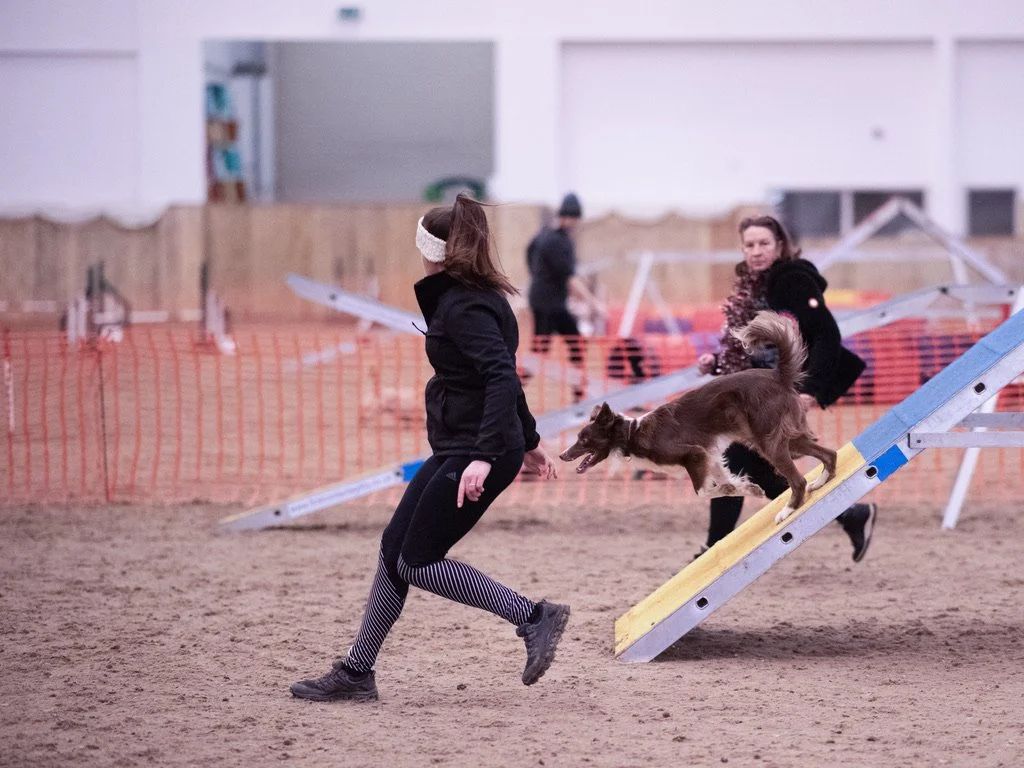
Agility
Agility is a sport where dog and handler navigate, off-leash at speed, around a course. It’s addictive, fast and very fun. Perfect for providing a structured outlet for chasing games, and fast-paced obedience at a distance.
Outlet match for: Herding/stockwork, task-based obedience, chase games, tug usually for rewarding, and more.
Obedience
Obedience is a very orderly, organised and professionally run dog sport where dog and handler combinations train for and compete with specific skills tested. Retrieves, scent detection, heelwork and positions are all involved here, and any dog can do it!
Outlet match for: Structured and task-based obedience, retrieve games, scentwork.
Scentwork
Where mantrailing follows a trail left by a person, scentwork aims to find specific articles in certain locations. Different organisations select certain odours to use as the target, but if you’re working from home, you can select anything for your odour!
Outlet match for: Scentwork, usually paired with task-based obedience
Canicross/bikejor
Canicross is running with your dog attached to your waist with a special harness, belt and lead combination. Bikejor includes a bicycle! It is competitive if you want it to be. Perfect for pulling outlets, or dogs and owners who simply LOVE to exercise together at speed!
Outlet match for: Pulling sports.
Gundog Tests
For the gundog group, you don’t need to go on a real shoot with guns to give your dogs an outlet. Working tests are the best target to work to, where dogs are scored on their heel, retrieves and whistle commands using canvas dummies as their quarry.
Outlet match for: Retrieve games, task-based obedience, hunting/quartering games, flush-and-recall games.
Barn hunt
In certain locations around the world, this fun activity is taking off. Barn hunt uses ethically sourced frozen rats as the target scent, sealed in safe containers to prevent contact, and tests a dog's ability to hunt and locate the capsule hidden in a barn-like setting.
Outlet match for: Scentwork (targets hunt drive, not prey drive)
Bite-sports
There are many different sub-groups in the bite sports umbrella, but all involve protection bitework and obedience. This sport should only ever be tackled under supervision from an experienced trainer with trained decoys. An outlet for grip-focused dogs, for sure.
Outlet match for: Detection/search, tug, carry and deliver, task-based obedience, protection sports.
Mantrailing
This sport is all about finding people who have taken a random path that the handler doesn’t know, but the dog has to follow. Using scent left behind, the combination heads out to track down their human quarry. It’s great fun for those who enjoy walking outdoors!
Outlet match for: Scent trails & tracking, scentwork.
Lure coursing
Lure coursing is one of the very best, legal and safest ways to provide a highly realistic outlet for sighthounds (and other dogs!). A realistic, fluffy object is dragged at speed across an open area as dogs chase down the quarry, going as fast as they can!
Outlet match for: Lure coursing, controlled chase games