
If you have a crazy Working Cocker Spaniel in a non-working home and don’t know what to do, please take a few minutes to read this post before you decide on any next steps.
Working cockers are not easy pet dogs, especially if they’re from shoot or trailing lines, so you need to start at the beginning to move forward.
Hopefully, this post and the matching YouTube video will help to provide some options.
This post exists because today there were 5 posts on social media from people saying they needed to rehome their working cocker spaniel because they were too much, too bitey, too sniffy, resource guarding, ‘dominating’ and more. At the time of the recording of that video, there were 3 more in the top section of my news feed alone.
Each one was a genuine last-chance decision-made situation, and I am not making this resource to shame those families. Absolutely not! I’m hoping that, with a bit of luck, someone else might see this before their cocker spaniel gets to the end of the road.
The paired video:
Step 1: Look at the food going in
It seems so ridiculous, but honestly, it isn’t. So many dog owners feed their dogs a diet of the wrong food, either a ‘working dog food’ because they overestimate the amount of activity their dog is doing, or they feed a complete food which is rammed with fillers that can create excess energy and reduce concentration.
Feed the correct food and amount for the dog you have, and make sure it is good quality food. Look for:
Grain/wheat/maize free
Dairy free
High meat content (>40% actual meat, not meat derivatives)
Certified complete food
Not for working dogs (unless your dog works 4+ hours day)
Millies Wolfheart Countryside mix is a good place to start if you have no current options on the table. It’s for 1.5 hours of exercise per day, and might just take the edge off. The bags can look expensive, but you don’t feed very much really, so it does even out.
Natural Instinct complete raw is an option if you’d prefer to go down that route. Avoid the working dog food if your dog is not working.
Step 2: Eliminate pain as a cause
Any dog can become problematic, aggressive or reactive if they are in pain. A vet check will assess eyes, ears, teeth and their body, but ideally, you want to look at the entire dog. Request a vet check for any changes in behaviour, specifically for:
Blood test
Urine test
Fecal (poo) test
Joint check
Working cockers have high incidences of luxating patella which is a painful slip of the kneecap in one or both hind legs. It can cause behavioural changes and sudden aggression. They also have the standard elbow, hip and back issues seen in other breeds, so check these with a vet and then move on.
Step 3: Learn about the breed
Cocker and Springer spaniels used to be one single breed, then they were split into two heights to do slightly different jobs. The cocker was named for the bird it excelled with, the woodcock. Woodcock live in woodlands, often quite dense with brambles and vegetation on the woodland floor. The cocker was small enough to get under these plants and work the cover to find the birds.
They’d then do as spaniels do, hunt hard and flush the bird. The bird would be shot, and the spaniel had to find them using their nose before carrying them some distance through a load of plants and sharp thorns, fighting their way through.
The cocker was therefore selected to be very good at hunting, chasing and carrying birds. They’re not natural-born retrievers, though some lines do have a stronger innate retrieve. Unlike labradors, the spaniel often needs additional training to bring the carried item back towards their humans; this is entirely normal.
If the dog you have is from working lines, and specifically with at least one working or trialing parent, their family will likely work for 8-10 hours per day, 4-6 days per week, 100+ days of the year.
Nowadays, Woodcock is a red-listed species, protected in most places and not the normal quarry for cockers. Instead, they lend their insane skills to flushing rabbits, partridge, grouse and pheasant, amongst other birds. They’re an incredibly versatile dog, doing the flushing, picking up and retrieving back to a gun in the field alongside springers, and often paired with labradors.
If you look at the predatory motor sequence selections for cockers that humans have done over the years, you end up with these key elements:
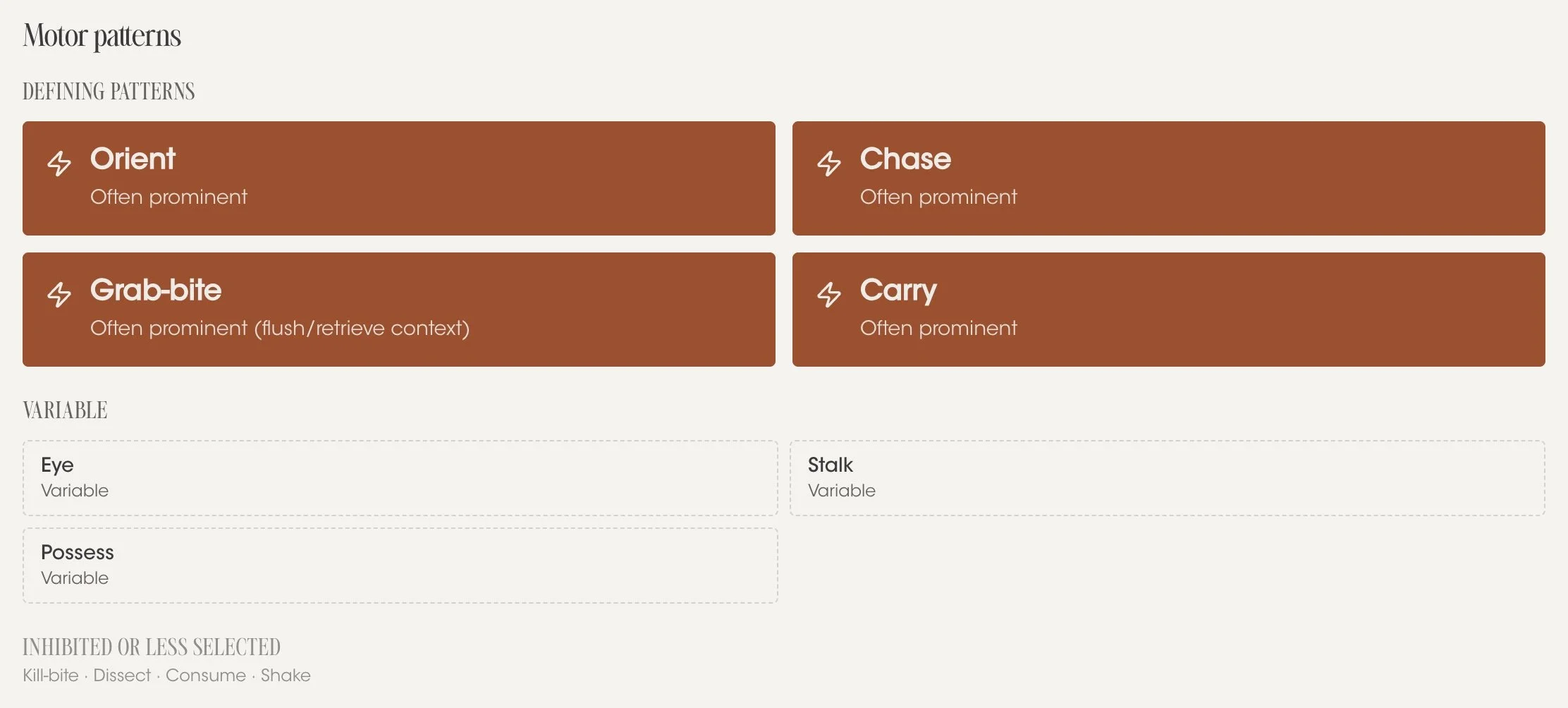
^ Cocker Spaniel Predator Motor Sequence - Click to view the breed profile
How this works in the average house:
Take the working cocker out of the working environment and you have a dog who looks innocent and adorable but is actually a scent machine on steroids, driven to find every interesting scent in the immediate area at warp speed, and then carry things like its life depends on it.
In a suburban or urban setting, these dogs need appropriate outlets for the intense desire to search and carry things around. Interrupt one or both of these things and the dog usually ends up frustrated and potentially reactive.
Not every cocker is the same, some are better able to adjust to non-working life and train down their drive, but others get stuck needing more than the situation can give them. They’ll carry things and protect them from being taken away, just like they would with a woodcock in a bramble bush, and they’ll be nose-to-the-ground and away when off the lead.
Step 4: Avoid resource guarding
Cockers have a reputation for resource guarding of items they think are valuable. This could be anything, but for them they are prizes to protect. It is likely that some lines are more likely to become possessive, but the biggest driver of resource guarding a lack of understanding from the human trying to access, or control access to, the resource in question.
If your dog already guards or shows aggression around objects, seek immediate help from a trainer.
Giving the dog to a rescue is not an option as they usually will not take or rehome dogs with existing bite histories. It is your responsibility as the caretaker of this dog to work through the problem and correct it.
If your dog does not currently guard resources:
Make sure you are proactive in the prevention of this behaviour. The simplest way to prevent it from developing is to ensure no items you don’t want the dog to have are left accessible to the dog. With the items that remain, train a retrieve to create an interactive cooperative game, regularly do a give-back and train a leave-it cue to drop or ignore other things in the area.
To do a give-back:
Take hold of an item the dog has
Wait until they release it (be patient)
Immediately give the item back and provide big praise
Repeat as the dog parades with glee
With a few repetitions, your dog will want to show you, and give you, all the items they find around the house and in the garden. This ensures that if you need to get hold of something dangerous that the dog has found, you can do so easily and swap it out for a safe item instead.
Step 5: Implement breed-specific outlets
With a vet check, a food check and an understanding of the breed itself, you need to provide breed-specific outlets for the dog in front of you. For working cockers, the following list is things that won’t help you fix your chaotic cocker:
Tricks / simple obedience training indoors
Kongs stuffed with food
Lick mats
Flyball (most of the time)
Canicross (some of the time)
^ These things WILL help entertain your dog, and relieve some excitement, as well as probably improving your bond too. You can absolutely carry on with these, but make sure you do things from the next list too…
Things that give your dog an outlet for their drive:
Scent detection (ideally complex searches after pre-training)
Gundog skills/drills/classes/tests
Agility training (ideally to a high level)
Mantrailing
^ These things tap into the cockers innate drive to hunt, search with their nose, chase down and do complex obedience at a distance, under pressure.
As an absolute minimum:
Train your dog to search for and find tennis balls in long grass or woodlands, then retrieve them to hand. Just this alone will make such a difference to their brains and bodies.
Step 6: Become a better trainer for them
You got your dog because you specifically wanted them, or they found you and needed you. That means that you need to also put in the effort to learn how to channel the incredible drive to work that they have into something productive.
Everyone has had their first tricky dog at some point, it’s just that some people haven’t had that dog yet. You’ll learn so much from working through this rough patch together, and in a few years you won’t be able to imagine life with any other dog!
It’s ok to be overwhelmed, but you are absolutely capable of stepping up and learning some new things to enable your dog to find its happy place in your life. It will be hard at first, but if you can get into a routine of training for 10 minutes per day, you’ll be astounded at the progress you make together.
For you, learn about:
Positive reinforcement and negative punishment (it’s not bad, even if it sounds it)
Reward timing
Reward frequencies and hierarchies
Environmental reinforcers
You can do this; trust yourself to turn this around 🙌